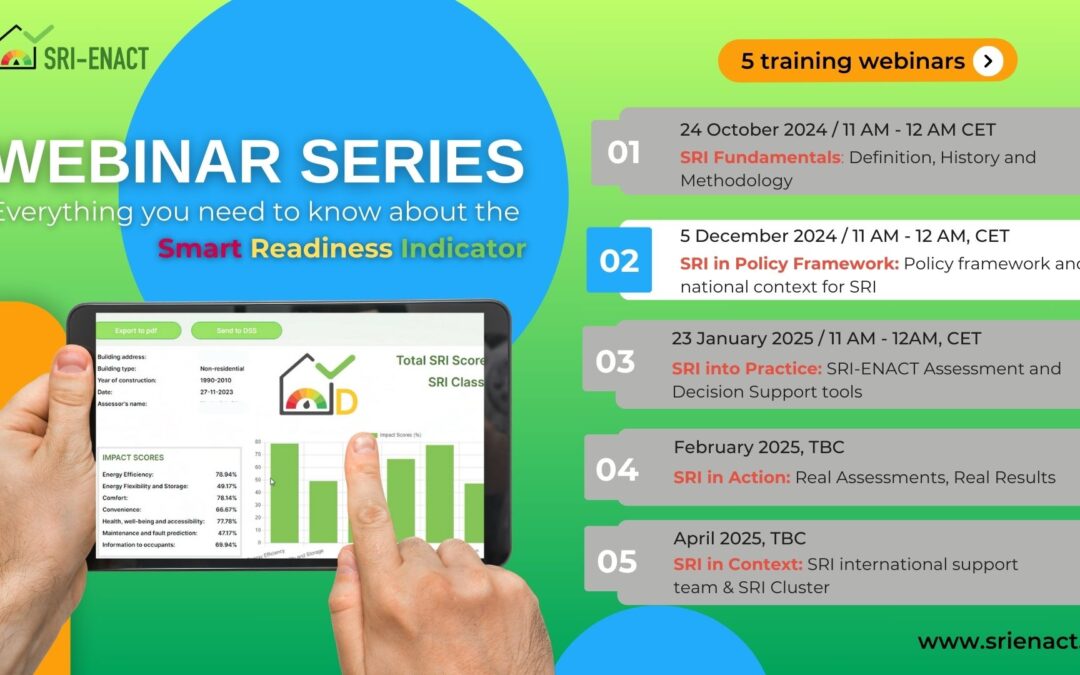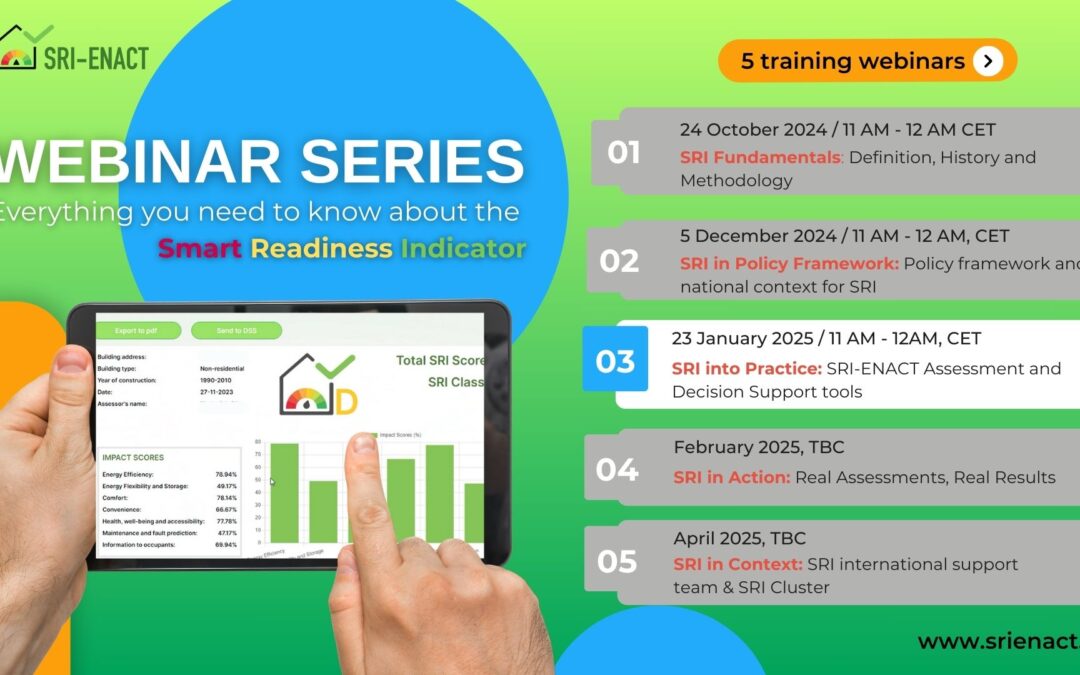
SRI into Practice: SRI-ENACT Assessment and Decision Support tools

SRI into Practice: SRI-ENACT Assessment and Decision Support tools

Join the SRI-ENACT Project for the third session in our webinar webinar series, where you’ll discover how the SRI-ENACT Toolkit can transform the way we assess and improve building performance. This session will showcase two innovative tools:
  • The SRI Assessment Tool, which simplifies the calculation of your building’s SRI score.
  • The SRI Decision Support Tool, designed to help you evaluate the impact of potential upgrades, estimate costs, and make informed, data-driven decisions to enhance your building’s performance.
WHO CAN JOIN?
This webinar is ideal for anyone who is passionate about driving sustainability and innovation in the built environment and wants to learn about the SRI concept – whether you’re a professional in the field, a policy maker or considering becoming an SRI auditor.
Agenda:
  • 11:00 – 11:05: Welcome & Introduction to the SRI-ENACT Toolkit (Stamatia Rizou, SLG)
  • 11:05 – 11:25Assessment Tool Demo: Calculate your building’s SRI score! (Stamatia Rizou, SLG)
  • 11:25 – 11:45Decision Support Tool Overview: Optimise building upgrades and investments for maximum impact (Apostolis Arsenopoulos, NTUA)
  • 11:45 – 12:00Q&A Session
Preliminary Results of Smart Readiness Indicator Assessments in Spain

Preliminary Results of Smart Readiness Indicator Assessments in Spain

As part of the ongoing European initiative to evaluate and improve the smart readiness of buildings, Spain has recently completed its initial phase of Smart Readiness Indicator (SRI) assessments. The evaluations, carried out by internal staff from Veolia Spain, focused on four buildings in the Valladolid region, providing valuable insights into the current state of smart technology integration in Spanish buildings.

The assessed buildings and their respective SRI scores are as follows:

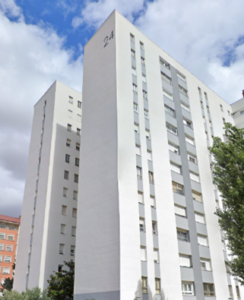
Avenida de la Libertad 24, Laguna de Duero: 26.8% F

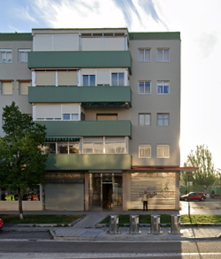
Paseo Arco de Ladrillo 91, Valladolid: 29.1% F

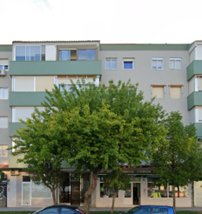
Paseo Arco de Ladrillo 89, Valladolid: 29.1% F

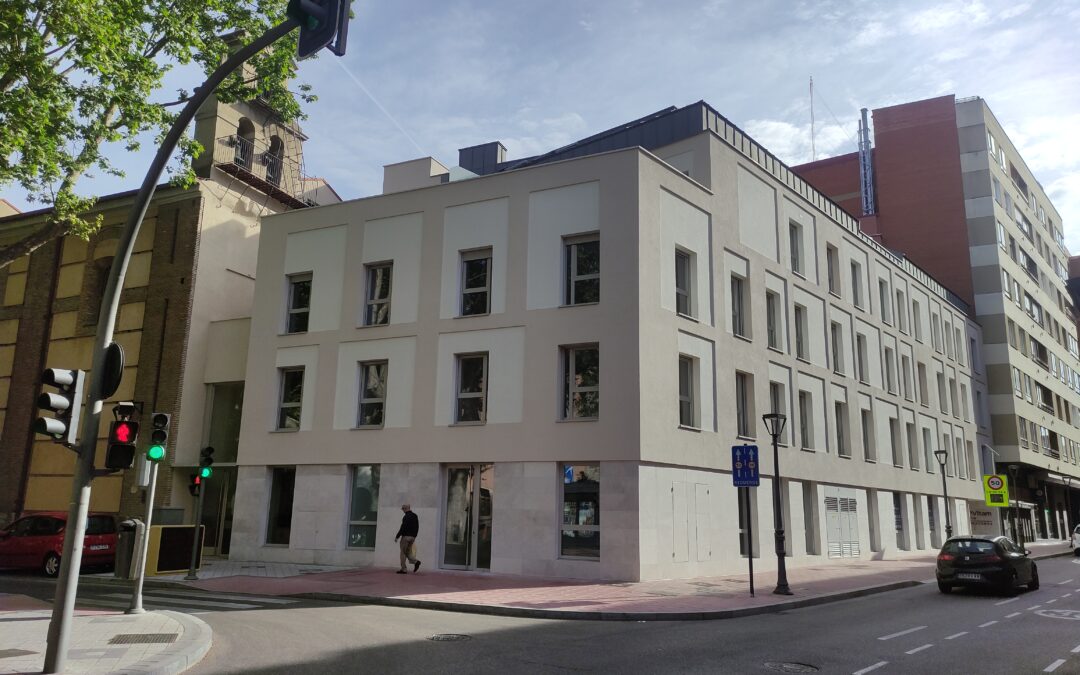
Calle de San Quirce 10, Valladolid: 48.9% E

These initial assessments reveal a range of smart readiness levels among the evaluated buildings. While three of the buildings scored in the 26–29% range, indicating significant room for improvement in smart technologies and systems, the building at Calle de San Quirce 10 in Valladolid achieved a notably higher score of 48.9%, reflecting more advanced smart features.

The variation in scores highlights the diverse state of smart technology adoption in Spanish buildings and underscores the potential for improvement across the building stock, particularly in areas such as energy efficiency, automation, and user comfort.

Veolia Spain’s role in conducting these assessments demonstrates the growing importance of smart building technologies in advancing sustainable urban development. As more buildings are evaluated and the data analyzed, valuable insights will emerge to guide future investments and policies in smart building technologies.

The SRI assessment initiative is set to continue, with plans to evaluate additional buildings across Spain. These efforts align with broader European goals to enhance building energy efficiency, reduce carbon emissions, and improve overall building performance through smart technologies.

As the project progresses, it will be crucial to analyze the specific factors contributing to higher SRI scores and identify common areas for improvement across Spanish buildings. This information will be invaluable for building owners, policymakers, and technology providers in shaping the future of smart buildings in Spain.

SRI in Policy Framework: Policy Framework and National Context for the Smart Readiness Indicator

SRI in Policy Framework: Policy Framework and National Context for the Smart Readiness Indicator

Buildings are among the largest sources of carbon emissions, and it’s clear we need to act now to reverse this trend. While building renovation is a long-term and costly process, there is a faster, smarter solution: leveraging smart technologies to control energy consumption. This is where the Smart Readiness Indicator (SRI) comes into play. The SRI helps assess how buildings can use smart technologies to optimize energy efficiency, enhance comfort, and improve overall performance—without the high costs and complexity of full-scale renovations.


To help you explore this game-changing approach, the SRI-ENACT project is hosting a series of five webinars. These sessions will cover everything you need to know about the SRI, from theoretical insights to practical building assessments. The webinars are ideal for anyone passionate about driving sustainability and innovation in the building sector, as well as those considering becoming future SRI auditors.


The second webinar in the series provides insights into the existing policy framework at the EU level. Additionally, representatives from eight SRI-ENACT pilot countries (Austria, Bulgaria, Croatia, Czech Republic, Greece, Latvia, Romania, and Spain) will discuss key topics raised by their ministries during the SRI testing phase and highlight barriers to implementation.


Agenda:

11:00 – 11:10   EU policy framework for the SRI (Marko Čavar, REGEA)

11:10 – 11:45   Highlights and challenges in implementing the SRI official test phase in the SRI-ENACT pilots (Greece, Bulgaria, Spain, Austria, Croatia, Czechia, Romania, Latvia)

11:45 – 12:00   Q&A


Register here

SRI Webinar series: 1) SRI Fundamentals: definition, history and methodology

SRI Webinar series: 1) SRI Fundamentals: definition, history and methodology

Buildings are one of the largest sources of carbon emissions, and it’s clear that we need to act now to reverse this trend. While building renovation is a long-term and costly process, there is a faster, smarter solution: leveraging smart technologies to control energy consumption. That’s where the Smart Readiness Indicator (SRI) comes into play. SRI helps evaluate how buildings can use smart technologies to optimise energy efficiency, enhance comfort, and improve overall performance—without the high costs and complexity of full-scale renovations.

To help you navigate this game-changing approach, the SRI-ENACT project is hosting a series of 5 webinars. These sessions will cover everything you need to know about the SRI, from theoretical insights to practical building assessments. These webinars are suitable anyone passionate about driving sustainability and innovation in the building sector, as well as individuals considering becomng future SRI auditors.


The first webinar will focus on an in-depth exploration of SRI fundamentals. We will present what is the Smart Readiness Indicator, the core SRI principles, services, and levels, and cover the objectives of the SRI assessment.


Agenda:

11:00 – 11:05 Introduction (Laura Junasová, Euroheat & Power)

11:05 – 11:25 History and definition of SRI (Christoph Schwarzenbacher, Blueprint Energy)

11:25 – 11:45 SRI features and methodology (Apostolis Arsenopoulos, NTUA)

11:45 – 12:00 Q&A


Register here

Successful Workshop on Smart Readiness Indicator Implementation in Thessaloniki

Successful Workshop on Smart Readiness Indicator Implementation in Thessaloniki

A highly successful workshop focusing on the Smart Readiness Indicator took place recently in Thessaloniki, hosted by the Centre for Research & Technology Hellas (CERTH) and organized by IsZEB Cluster. The event brought together key experts from the fields of energy, construction, and technology, highlighting the pilot phase of SRI implementation in Greece.

The workshop, attended by researchers, academics, energy inspectors, and market representatives, provided valuable insights into how smart buildings can leverage innovative technologies to enhance sustainability and energy efficiency. Presentations covered a range of building types and their smart readiness potential.

Keynote speaker Robert Sylvain, coordinator of the LIFE CET Cluster of CINEA, discussed smart building policies, while real-time SRI assessments and collaborative efforts across four European projects—SRI-ENACT, easySRI, Smart Square Project, and SRI2MARKET—were showcased.

The workshop’s success marked another important step in advancing smart and sustainable building practices in Greece and beyond.

Read the press release: here